Loading...
Searching...
No Matches
◆ LWGEOM_snaptogrid_pointoff()
| Datum LWGEOM_snaptogrid_pointoff | ( | PG_FUNCTION_ARGS | ) |
Definition at line 399 of file lwgeom_functions_analytic.c.
400{
401 GSERIALIZED *in_geom, *in_point;
402 LWGEOM *in_lwgeom;
403 LWPOINT *in_lwpoint;
404 GSERIALIZED *out_geom = NULL;
405 LWGEOM *out_lwgeom;
406 gridspec grid;
407 /* BOX3D box3d; */
408 POINT4D offsetpoint;
409
410 in_geom = PG_GETARG_GSERIALIZED_P(0);
411
412 /* Return input geometry if input geometry is empty */
414 {
415 PG_RETURN_POINTER(in_geom);
416 }
417
418 in_point = PG_GETARG_GSERIALIZED_P(1);
420 if ( in_lwpoint == NULL )
421 {
422 lwpgerror("Offset geometry must be a point");
423 }
424
425 grid.xsize = PG_GETARG_FLOAT8(2);
426 grid.ysize = PG_GETARG_FLOAT8(3);
427 grid.zsize = PG_GETARG_FLOAT8(4);
428 grid.msize = PG_GETARG_FLOAT8(5);
429
430 /* Take offsets from point geometry */
436
437#if POSTGIS_DEBUG_LEVEL >= 4
438 grid_print(&grid);
439#endif
440
441 /* Return input geometry if input grid is meaningless */
443 {
444 PG_RETURN_POINTER(in_geom);
445 }
446
447 in_lwgeom = lwgeom_from_gserialized(in_geom);
448
450
451 out_lwgeom = lwgeom_grid(in_lwgeom, &grid);
452 if ( out_lwgeom == NULL ) PG_RETURN_NULL();
453
454 /* COMPUTE_BBOX TAINTING */
456 {
457 lwgeom_refresh_bbox(out_lwgeom);
458 }
459
461
462 out_geom = geometry_serialize(out_lwgeom);
463
464 PG_RETURN_POINTER(out_geom);
465}
LWGEOM * lwgeom_from_gserialized(const GSERIALIZED *g)
Allocate a new LWGEOM from a GSERIALIZED.
Definition gserialized.c:239
int gserialized_is_empty(const GSERIALIZED *g)
Check if a GSERIALIZED is empty without deserializing first.
Definition gserialized.c:152
const char * lwtype_name(uint8_t type)
Return the type name string associated with a type number (e.g.
Definition lwutil.c:216
void lwgeom_refresh_bbox(LWGEOM *lwgeom)
Drop current bbox and calculate a fresh one.
Definition lwgeom.c:689
int lwgeom_has_z(const LWGEOM *geom)
Return LW_TRUE if geometry has Z ordinates.
Definition lwgeom.c:916
int getPoint4d_p(const POINTARRAY *pa, uint32_t n, POINT4D *point)
Definition lwgeom_api.c:125
int lwgeom_has_m(const LWGEOM *geom)
Return LW_TRUE if geometry has M ordinates.
Definition lwgeom.c:923
GSERIALIZED * geometry_serialize(LWGEOM *lwgeom)
Definition liblwgeom.h:429
Definition liblwgeom.h:443
Definition liblwgeom.h:455
Definition liblwgeom.h:399
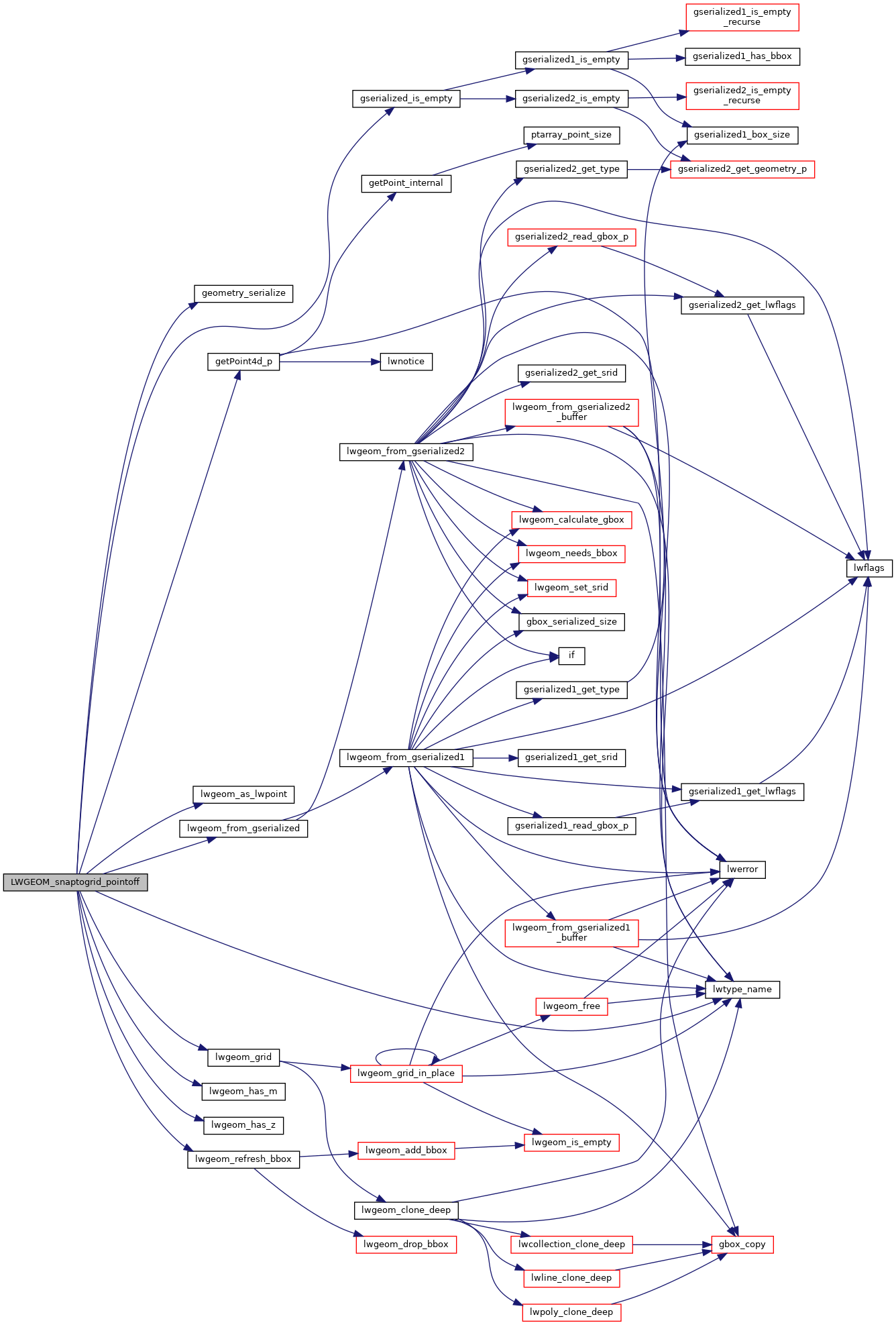
References LWGEOM::bbox, geometry_serialize(), getPoint4d_p(), gserialized_is_empty(), gridspec_t::ipm, gridspec_t::ipx, gridspec_t::ipy, gridspec_t::ipz, lwgeom_as_lwpoint(), lwgeom_from_gserialized(), lwgeom_grid(), lwgeom_has_m(), lwgeom_has_z(), lwgeom_refresh_bbox(), lwtype_name(), POINT4D::m, gridspec_t::msize, LWPOINT::point, LWGEOM::type, POINT4D::x, gridspec_t::xsize, POINT4D::y, gridspec_t::ysize, POINT4D::z, and gridspec_t::zsize.
Here is the call graph for this function: